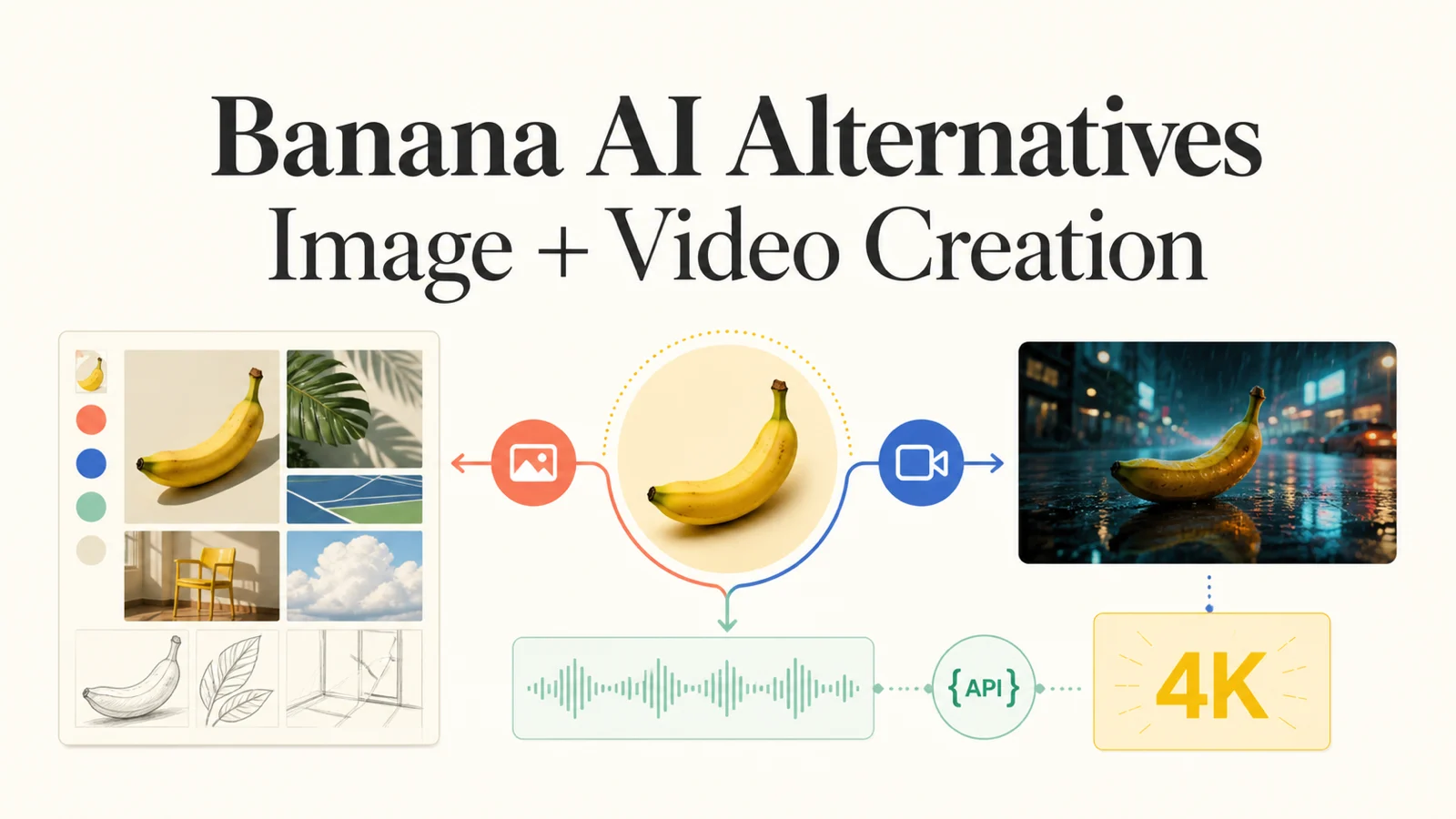
Banana AI alternatives are not one uniform category. A creator may want a stronger video editor, an Adobe-centered production suite, an image-first style engine, or an API for instruction-following edits. Each job needs a different review loop and cost model.
This list compares five alternatives by reference control, output fit, predictable revisions, and the manual assembly left for the team. The shortlist covers Adobe Firefly, Runway, Kling AI, Midjourney, and OpenAI GPT Image 2 plus Sora.
Use the list to identify the replacement layer that solves the real constraint.
Best Banana AI alternatives at a glance
| Alternative | Best fit | Media coverage | Strongest control | Main tradeoff |
|---|---|---|---|---|
| Adobe Firefly | Teams already working in Adobe | Images, video, audio, and design | Generative editing inside a broader creative suite | More plan, credit, and model choices to evaluate |
| Runway | Video-first campaigns and product clips | Video, images, and partner models | Motion quality, references, and model choice | Credits make repeated video revisions expensive |
| Kling AI | Native audio, motion control, and 4K output | Images and video | Image-to-video, reference inputs, and motion control | Output settings and credit rules need close review |
| Midjourney | Image-led art direction with short motion tests | Images plus image-to-video | Visual exploration and start-frame animation | Video remains an extension of the image workflow |
| OpenAI GPT Image 2 + Sora | Instruction-following image production and API work | Images plus Sora video | Programmatic edits, output settings, and prompt control | The Sora 2 video branch has a published shutdown warning |
How we evaluated these alternatives
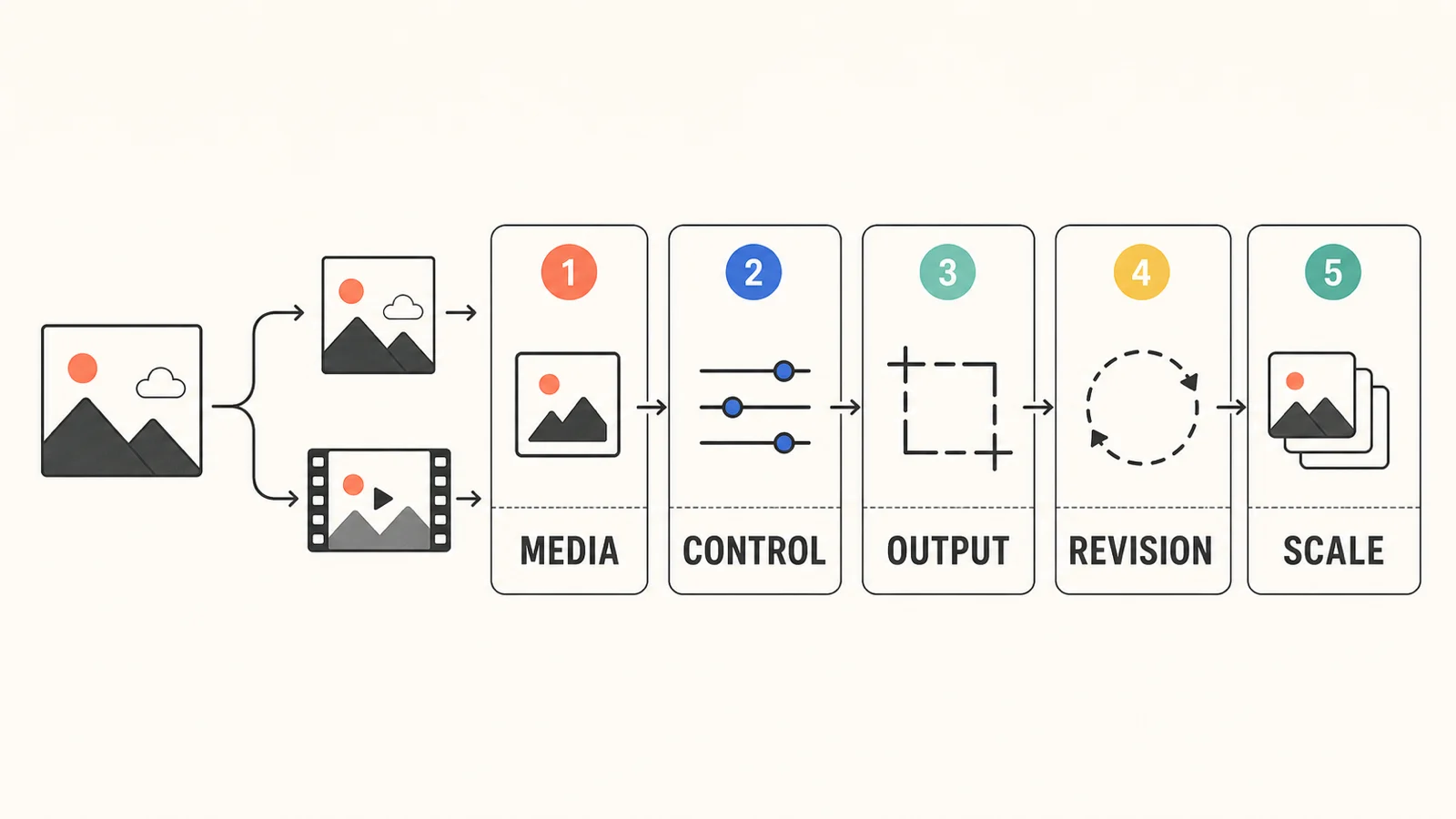
The useful question is which system reaches an approved asset with fewer expensive corrections. I used five dimensions:
- Media coverage: Can the service handle the actual mix of stills, short video, audio, or design work?
- Reference control: Can you preserve a product, person, layout, or opening frame while changing the scene?
- Output fit: Do the aspect ratios, duration, resolution, and export options match the channel?
- Revision cost: How much does a small correction consume in credits, time, or manual cleanup?
- Usability: Can a designer move from prompt to review without building an extra provider layer?
1. Adobe Firefly: Best for a cross-media creative suite
Adobe Firefly is the broadest alternative here. Its current product surface covers image, video, audio, vector, and design generation, plus partner models from companies such as Google, OpenAI, and Kling AI. It fits teams that already finish work in Photoshop, Illustrator, Premiere, or other Adobe applications.
The advantage is continuity. A campaign can move from a generated image to a video concept and into a familiar design environment, with Adobe tools handling compositing, typography, and final production.
The control question is more complicated. Adobe and partner models create more routes to test, along with more plan rules, credits, model availability, and export behavior. Record which model produced an approved asset and whether a revision stays in the same cost band.
Choose Firefly when the bottleneck is cross-media handoff inside Adobe. Choose a focused service when rapid reference-image iteration matters more.
2. Runway: Best for video-first campaigns
Runway is the clearest choice when the main deliverable is a short video. Its official Gen-4.5 material emphasizes motion quality, prompt adherence, and visual fidelity. The workspace also brings image, video, and partner models together for provider comparisons.
That breadth helps during pre-production. A team can create a product still, test a reference-led shot, and compare motion behaviors without moving assets between accounts. This matters when packaging and framing must survive iterations.
Runway's current pricing page lists Gen-4.5 at 12 credits per second, or 60 credits for a five-second clip. The same page lists Standard at US$12 per month when billed annually with 625 monthly credits. Treat those figures as a live plan snapshot, not a permanent production estimate. Model rates, included models, and regional billing can change.
Runway fits a video review loop well, but its credit model makes another variation a budget decision. Use it when temporal consistency matters more than the lowest cost per still image.
3. Kling AI: Best for native audio, motion control, and 4K
Kling AI is a video-first alternative with a strong image side. Its current product messaging highlights Kling 3.0 and 3.0 Omni, native audio, consistency control, reference inputs, motion control, 4K video, and 2K or 4K image output.
That combination suits product demos and social ads that turn a source image into a moving shot. Native audio helps when the soundtrack belongs in the first generation. The public API pricing separates image units from video seconds, but the exact rate still depends on model, resolution, audio, and duration.
Kling's main cost is configuration discipline. A test that changes duration, resolution, audio, or reference mode can move into a different price and quality tier. Capture those settings with the prompt and source asset so the approved result can be reproduced.
Choose Kling when motion control and native audio are part of the brief. It is less attractive for mostly still-image editing.
4. Midjourney: Best for image-led visual development
Midjourney remains an image-first choice. Its official V1 video announcement describes a direct path from a still to a short animated clip: create the image, select Animate, choose high or low motion, and extend the result. It also describes animating an uploaded image as a start frame.
That shape is valuable during art direction. A team can explore a visual language in still images, then turn approved frames into motion tests for a pitch or storyboard. The image remains the source of truth.
The same strength defines the limitation. Midjourney's video path is an image extension, not a complete video production environment. Teams that need precise timing, audio control, or multiple references will still need an editor or video-first generator.
Choose Midjourney when visual identity comes before production mechanics. It is a poor replacement for a full image-and-video workspace when motion, framing, and audio revisions must happen together.
5. OpenAI GPT Image 2 plus Sora: Best for instruction-following image work
OpenAI is a useful alternative for instruction-following image generation and programmatic edits. The current image documentation describes GPT Image models, including GPT Image 2, through the Image API and Responses API, with controls for quality, size, format, compression, and supported transparent backgrounds.
This API surface suits product teams building image generation into an application, catalog system, or internal review queue. Store the input image, prompt, output settings, and revision history at the request boundary.
Sora should be treated separately from the image recommendation. The official video API documentation currently warns that Sora 2 models and the Videos API will shut down on September 24, 2026. That makes Sora a poor foundation for a new long-lived video pipeline, even if a short experiment produces a good clip.
Choose OpenAI for API-centered image work and structured edits. Choose a different video branch for a durable production roadmap.
Choose by creative job
| Creative job | Start with | Why it fits | Review before committing |
|---|---|---|---|
| Prompt and reference-image creation in one browser workspace | Banana AI | Shortens the path from source image to image or video draft | Check model-specific ratios, resolution, credits, and export behavior |
| Adobe-centered campaign production | Adobe Firefly | Keeps generation near compositing, typography, and finishing tools | Confirm partner-model access and credit treatment |
| Product demos with demanding motion | Runway or Kling AI | Both prioritize video creation, with different control and cost shapes | Test the same reference across duration, aspect ratio, and resolution |
| Image-led style exploration | Midjourney | Starts with still art direction and extends approved frames into motion tests | Measure how much video editing remains after generation |
| Automated image editing and rendering | OpenAI GPT Image 2 | Gives application teams a structured API path | Store prompts and settings, then verify output consistency |
An alternative should earn its place through a repeatable test. Use one product or character and the same reference to request a landscape image, a vertical image, and a short video. Record reference count, ratio, resolution, duration, time, and credit use. Then make one revision that changes only the background or camera move.
The second output exposes the difference. It shows whether the system preserves the subject, follows the edit, and avoids a full scene restart.
When Banana AI remains the simpler fit
Leaving Banana AI only makes sense when an alternative solves a specific constraint better. Banana AI currently presents text and reference-image generation for stills, plus short video creation from prompts, images, and guided frames. It covers a useful middle ground without requiring a separate provider workflow.
Start with the Banana AI image generator when the brief begins with a reference image or needs several image directions. Move to the Banana AI video generator when the approved still needs a short product, social, or concept clip. Before estimating recurring work, check Banana AI pricing against the number of revisions rather than the number of first drafts.
Readers focused on still-image editing can also compare this list with our guide to Nano Banana alternatives for image editing. The right choice may be a second route for one stage, not a full replacement.
FAQ
What is the closest all-in-one Banana AI alternative?
Adobe Firefly is the closest match for broad image, video, audio, and design coverage in a creative suite. Runway is closer for video-first work with image and partner models. Choose based on finishing tools, motion control, API access, or reference iteration.
Which alternative is best for product demo videos?
Start with Runway when motion quality leads the brief. Test Kling AI when native audio, motion control, or 4K output matters. Compare the second revision before evaluating the first clip.
Which alternative is best for image editing?
OpenAI GPT Image 2 is a strong candidate for instruction-following edits and API-driven production. Midjourney is better suited to visual exploration than precise asset correction. Adobe Firefly fits teams that need image generation next to compositing and design work.
Is Sora 2 a durable video replacement?
The current official API documentation says the Sora 2 models and Videos API will shut down on September 24, 2026. That published date makes Sora unsuitable as the sole foundation for a new long-lived video pipeline. Treat it as an experiment and confirm the current migration guidance before committing production work.
Should a team use more than one alternative?
Yes, if each service owns a clear job. One can handle still-image direction, another motion, and a third final edits. Keep the source asset, prompt, settings, and license record together so the handoff preserves the approved output's decisions.