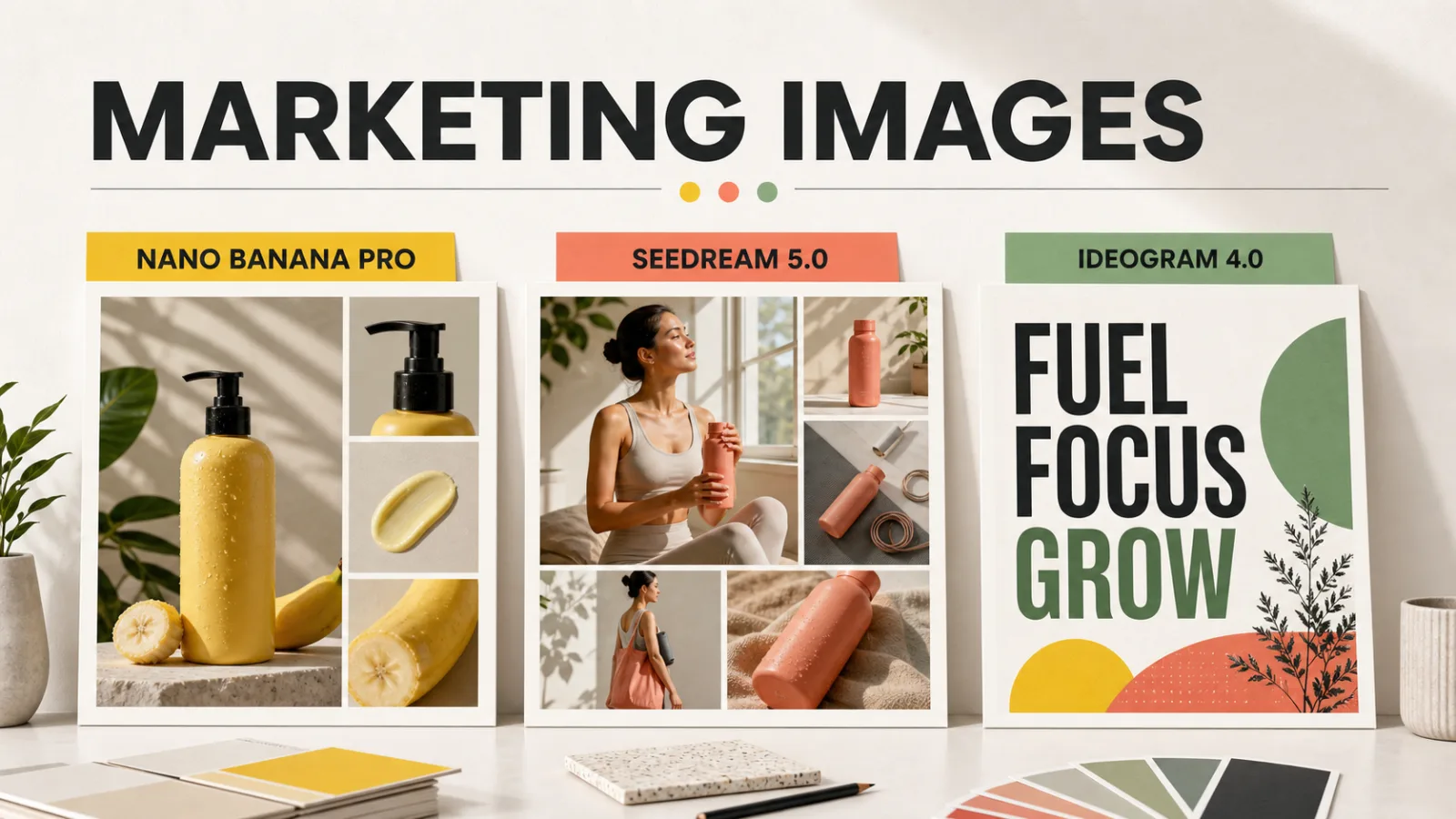
Marketing images are judged twice: first as a visual idea, then as a usable asset. A product ad can look polished and still fail because the bottle changed, the headline is wrong, or the layout cannot be resized for another channel.
Nano Banana Pro, Seedream 5.0, and Ideogram 4.0 approach that production problem from different directions. Nano Banana Pro is strongest when a reference image and a complex edit drive the brief. Seedream 5.0 is aimed at multimodal creation, design understanding, and structured compositions. Ideogram 4.0 puts text, layout, and open model access closer to the center of the workflow.
There is no useful universal winner here. The better starting point depends on the asset you need to approve.
Nano Banana Pro vs Seedream 5.0 vs Ideogram 4.0 at a glance
| Model | Best starting point | Main control signal | Useful output fit | Main revision cost |
|---|---|---|---|---|
| Nano Banana Pro | Reference-led product edits and complex creative direction | Text plus reference images, conversational edits, and high-resolution options | Product ads, hero images, branded variations, and multi-step edits | A small change can alter the scene, so protect the product identity during each rerun |
| Seedream 5.0 | Structured campaign compositions with several visual elements | Multimodal prompts, design intent, layout, and image-text alignment | Lifestyle campaigns, collages, infographics, and art-directed product scenes | Exact packaging copy and small details still need a close proof pass |
| Ideogram 4.0 | Text-heavy ads, posters, social graphics, and layout drafts | Natural-language or structured prompts, text placement, and bounding-box layout control | Headlines, CTAs, brand mockups, 1K or 2K design outputs | Product identity and fine brand details may need a separate reference-edit pass |
How to evaluate a model for marketing images
The first generation is not enough. A marketing image is useful only when it survives the second request and can be exported in the shape the channel needs.
Use one approved product reference and run the same brief through each model. Score five dimensions:
- Reference control: Does the silhouette, label area, material, and color remain recognizable?
- Composition control: Can you place the product, model, negative space, and visual hierarchy where the campaign needs them?
- Text behavior: Are the headline, price, CTA, and short labels readable and correctly spelled?
- Output fit: Do the ratio, resolution, and export route match the ad, landing page, or social placement?
- Revision cost: When you change only the background or headline, how much of the approved image moves with it?
The most revealing test is a constrained revision. Ask for one change, such as replacing a warm studio background with a cool outdoor scene while keeping the product unchanged. Then ask for a second change that affects only the headline. A model that produces an attractive first draft but forces a full restart on every correction will cost more time than its first output suggests.
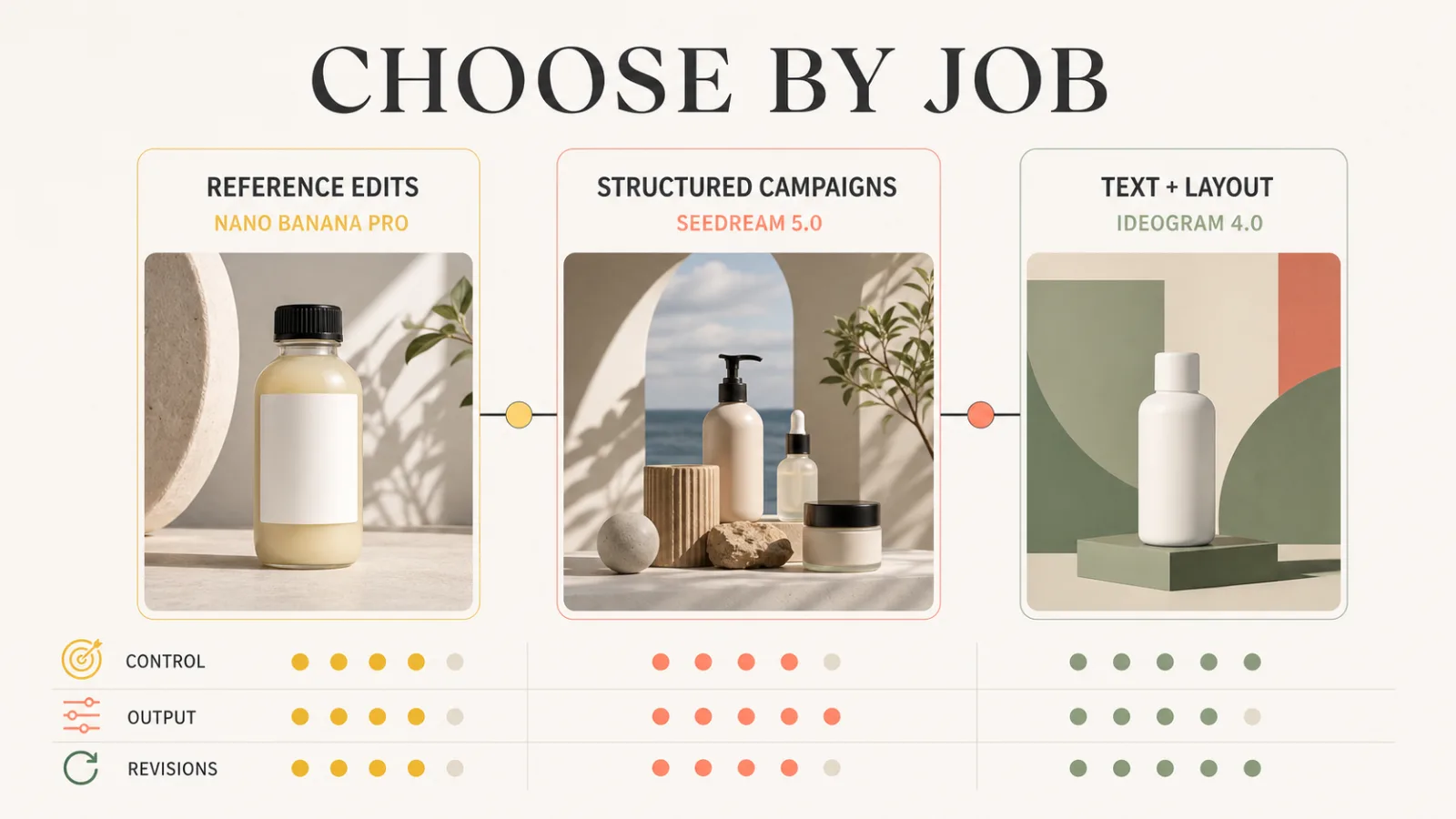
Nano Banana Pro: best for reference-led product edits
Nano Banana Pro is Google's name for Gemini 3 Pro Image. Google's current developer documentation positions it as the professional option for complex visual tasks, with advanced control, world knowledge, brand consistency, and output up to 4K. The same image workflow supports text and image input, conversational editing, and model-specific output settings.
That makes it a strong starting point for a product image that already has a source of truth. Give it the approved packshot, a reference for the campaign mood, and a clear instruction about what may change. It can then work on the scene, lighting, crop, or supporting objects without treating the product as a completely new subject.
Nano Banana Pro is useful for:
- Reframing a product into a seasonal campaign scene.
- Creating several aspect-ratio directions from one approved reference.
- Changing color, setting, or supporting props while preserving the main subject.
- Iterating through a conversational edit loop instead of rebuilding the prompt from zero.
The tradeoff is identity protection. Complex generation can improve the whole composition while quietly changing a logo area, cap shape, button, or label. Review those details at full size after every meaningful edit. Google's API documentation also notes that generated images include a SynthID watermark, so confirm the final export behavior when a direct API route is part of the production plan.
Within Banana AI, the current image catalog exposes Nano Banana Pro for image-to-image work. Its current surface accepts up to eight reference images, offers aspect ratios from 1:1 through 21:9, and exposes 1K, 2K, and 4K resolution options plus PNG or JPG output. That is a useful fit for teams that want reference editing in one browser workspace rather than a separate API integration.
Choose Nano Banana Pro first when the approved reference matters more than exact in-image typography.
Seedream 5.0: best for structured campaign compositions
Seedream 5.0 is a family rather than one completely interchangeable endpoint. ByteDance Seed's current pages distinguish Seedream 5.0 Pro and Seedream 5.0 Lite. The Pro release describes a multimodal image generation model with advanced reasoning, efficient content creation, and professional production capabilities. Its launch material also emphasizes image-text alignment, structural coherence, real-world lighting, object materials, and skin texture.
That profile fits a brief with several relationships to manage: a product on a set, a person using it, supporting props, a defined mood, and a composition that must feel intentional rather than randomly assembled. It is a good candidate for a campaign board, lifestyle product scene, infographic-style visual, or a set of variations that shares a visual logic.
Seedream 5.0 is useful for:
- Building a composed lifestyle image with several objects and clear hierarchy.
- Turning a written design direction into a more complete visual arrangement.
- Exploring product scenes before a designer locks the final layout.
- Combining reference images with a broader art direction brief.
The main caution is model naming. Seedream 5.0 Pro and Lite should not be treated as the same product or the same price. Banana AI's current catalog exposes Seedream 5.0 Lite in both text-to-image and image-to-image modes. The current hosted controls include up to 14 reference images, basic or high quality, and ratios from 1:1 through 21:9. That is the variant to test inside Banana AI. The official Pro page is useful for understanding the family direction, but it is not evidence that Banana AI hosts the Pro endpoint.
Seedream is a good starting point when the hard part is coordinating the whole scene. It is less suitable to treat as a final packaging proof without checking text, edges, and small product details manually.
Ideogram 4.0: best for text and layout
Ideogram 4.0 is the clearest fit when the marketing image needs to carry a message. Ideogram's current release materials describe frontier-grade text rendering across languages, bounding-box layout control, and 2K photoreal output. The model is also released as an open-weight model, with public weights and inference code called out in the technical documentation.
The current v4 API exposes two different prompt paths: a natural-language text_prompt or a structured json_prompt that follows the Ideogram 4.0 contract. It supports 1K and 2K resolutions. The API returns image links that are available for a limited period, so a production integration must download and store approved outputs rather than treating the response URL as permanent storage.
Ideogram 4.0 is useful for:
- Social ads with a short headline and a clear call to action.
- Posters, event graphics, packaging concepts, and branded layout drafts.
- Early campaign exploration where typography is part of the visual idea.
- Teams that want an open-weight route for experimentation or customization.
Text control reduces one kind of revision cost, but it does not remove proofing. Check spelling, punctuation, trademarked terms, logo treatment, and the relationship between the copy and the image. For a photoreal product scene where the reference object must remain exact, start with a reference-edit model and add the final copy in a design tool if needed.
Choose Ideogram 4.0 first when the words and their placement are part of the asset, not a finishing detail.
Choose by marketing job
| Marketing job | Start with | Why it fits | What to check before approval |
|---|---|---|---|
| Product cutout or packshot moved into a new campaign scene | Nano Banana Pro | Reference-led editing and high-resolution options keep the source object central | Label, silhouette, materials, reflections, and every required ratio |
| Lifestyle campaign with several props, people, and visual relationships | Seedream 5.0 | Design intent and structural coherence help shape the whole composition | Subject count, hierarchy, hands, product details, and scene consistency |
| Social graphic with a headline, CTA, or short promotional copy | Ideogram 4.0 | Text rendering and layout control address the message inside the image | Exact spelling, brand terms, safe margins, and platform crop |
| A/B variations from one approved reference | Nano Banana Pro or Seedream 5.0 Lite | Both are available in Banana AI's image catalog with reference inputs | Which model preserves the approved subject after the second revision |
| Open-weight experimentation or a custom inference route | Ideogram 4.0 | The official release provides open weights and inference code | Licensing, infrastructure, moderation, storage, and support ownership |
The decision should follow the asset's most expensive failure. If a changed product label would invalidate the image, prioritize reference control. If a wrong headline would make the ad unusable, prioritize text and layout. If the whole scene feels incoherent, prioritize composition and structural control.
A practical Banana AI comparison workflow
Banana AI currently exposes Nano Banana Pro and Seedream 5.0 Lite in its active image catalog. Ideogram 4.0 is not part of that catalog, so treat it as an external comparison route rather than a hosted Banana AI model.
For a repeatable test, open the Banana AI image generator and keep these inputs fixed:
- One approved product reference with a readable label.
- One brief for a 16:9 landing-page hero.
- One short headline that must remain accurate.
- One revision request that changes only the setting.
- One output review covering identity, copy, ratio, and storage.
Run Nano Banana Pro and Seedream 5.0 Lite in the same workspace, record the selected model settings, and save the prompt with the approved image. For Ideogram 4.0, use the official surface or API and keep its prompt and downloaded output beside the other candidates. Do not compare only the first image. Compare the second revision and the amount of cleanup left for the team.
Pricing is also wrapper-specific. In Banana AI's current catalog, Nano Banana Pro starts at a 15-credit base before its 4K factor, while Seedream 5.0 Lite starts at an 8-credit base. Those are Banana AI billing values, not Google's or ByteDance's official API prices. Check Banana AI pricing before estimating a campaign with many reruns, and keep Ideogram's separate usage and storage terms in its own budget.
For a broader reference-editing comparison, the Nano Banana Pro vs GPT Image 2 vs FLUX.2 comparison covers a different model set. For product-photo workflow decisions around identity and scene control, the ecommerce product photo comparison is the closer companion.
FAQ
Which model is best for text in marketing images?
Ideogram 4.0 is the strongest starting point when readable text and layout are the primary requirements. Still proofread every headline, price, CTA, and brand term before publishing.
Which model is best for editing a product reference?
Nano Banana Pro is the better first test when the source object must remain central while the scene changes. Check the label, silhouette, and materials after each rerun instead of judging only the overall composition.
Is Seedream 5.0 Pro the same as Seedream 5.0 Lite?
No. ByteDance Seed presents them as separate variants. Banana AI currently exposes Seedream 5.0 Lite, not the Pro endpoint. Use the hosted Lite controls and pricing when evaluating Banana AI, and do not transfer Pro claims or rates to Lite without verification.
Should the final headline be generated inside the image?
Only when the model gives the team enough control and the copy is short. For regulated claims, dense pricing, or a logo that must be exact, generate the visual direction first and add final typography in the normal design handoff.
Is there one best model for every marketing team?
No. Choose by the failure that costs the most: lost product identity points to Nano Banana Pro, an incoherent multi-element scene points to Seedream 5.0, and incorrect text or layout points to Ideogram 4.0. A two-model workflow can be more practical than forcing one model to own every stage.